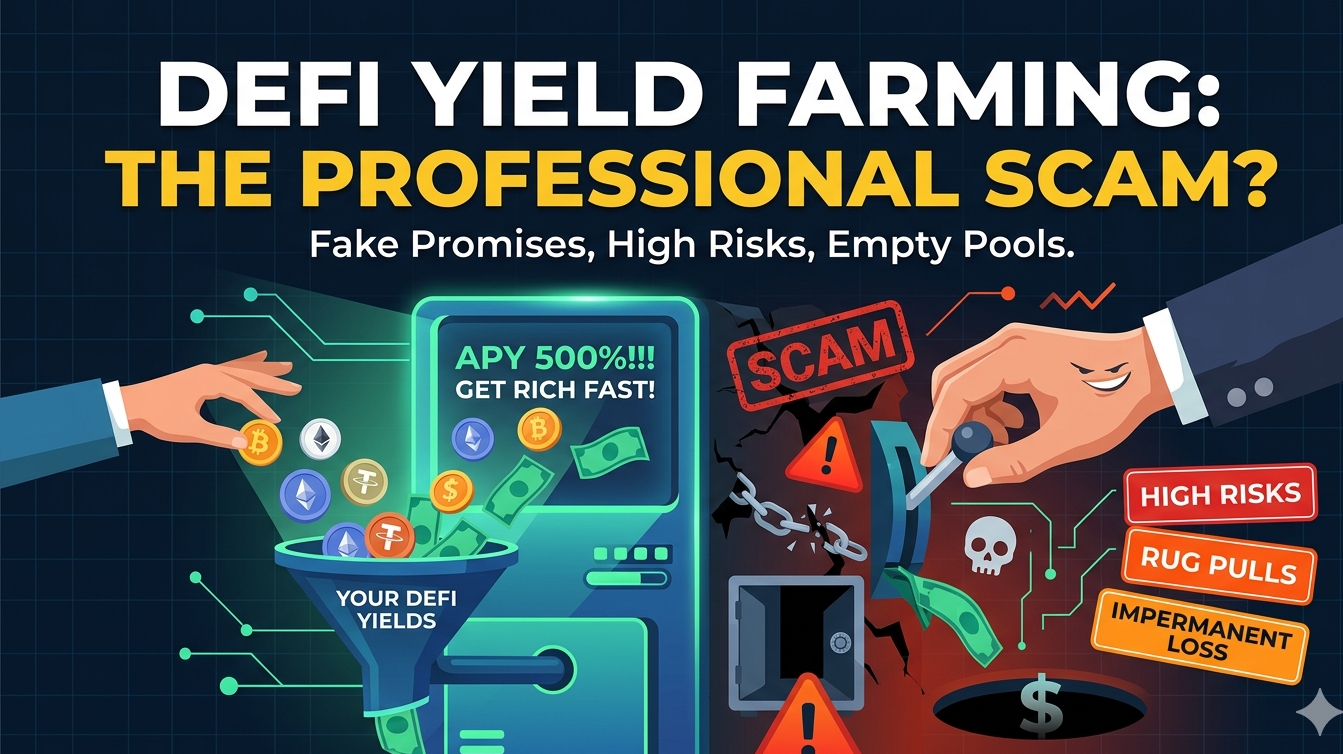
Every few months, a new wave of investors discovers DeFi yield farming. They see the dashboards. They see the fake annual percentage yields that would make any Wall Street banker's jaw drop;5%, 12%, sometimes 30% and beyond. They then read the threads, watch the tutorials, and convince themselves that this time, they have found the edge. The secret the banks do not want them to know.
Then they lose money. Sometimes a little, sometimes everything in their savings!
This article is not written to tell you that DeFi is useless or that blockchain finance has no future. It has a future, and parts of it are genuinely transformative. But yield farming, as it is packaged and marketed to the average retail investor, is one of the most elegantly designed wealth transfer mechanisms in the history of financial products. And the people transferring wealth are almost never the ones farming.
Here is what the tutorials leave out.
The numbers that hook you are never the numbers you actually earn
Let us start with the most visible deception: the advertised APY.
When a protocol displays a yield of 8%, that number is calculated based on current reward emissions, current token prices, and current pool sizes. And the fact is that all of this always change by the hour. By the time you deposit your funds, read the confirmation, and check back the next morning, that yield has already shifted. Sometimes dramatically to almost nothing.
Here is the mechanical reason. When a farming pool advertises high returns, it attracts new capital. As more capital flows in, the same reward pool gets split among more depositors. The yield per user drops. And all this is not a flaw in the system, it is the system working exactly as designed. The early participants capture the majority of returns. Late arrivals subsidise them.
The protocols know this, their marketing materials do not mention it.
What you will actually earn, net of gas fees, reward token depreciation, and the time cost of active management, is almost always a fraction of what the headline number suggested. For many retail participants, it is negative. So, they attract you so that you lose money if you are a retail investor!
Impermanent loss kills portfolios
If there is one concept that separates those who truly understand yield farming from those who are about to learn an expensive lesson, it is impermanent loss.
When you provide liquidity to a decentralised exchange pool, you deposit two tokens in equal value. Lets say ETH and a partner token. The pool's automated mechanism continuously rebalances those tokens as prices shift. If one token rises significantly in price, the pool sells some of it for the other, leaving you with less of the appreciating asset than you originally deposited.
The mathematics are unforgiving. If one token in your pair doubles in price while the other stays flat, you suffer approximately 5.7% impermanent loss versus simply holding both tokens. If one token rises five times in value, that loss climbs to around 25%. The more volatile the pair, the deeper the damage.
The word impermanent is technically accurate. If prices do return to their original ratio, the loss disappears. But in crypto markets, prices rarely retrace to exact starting points. In practice, impermanent loss becomes permanent the moment you withdraw your liquidity, which most farmers eventually must.
The cruel irony is this, in a bull market, where most tokens are rising, impermanent loss tends to eat the gains that the high APY was supposed to deliver. You would have been better off simply holding the tokens in your own wallet.
The rug pull economy
Beyond the mathematical traps, there is an entire category of yield farming risk that is not accidental at all. It is intentional.
Rug pulls occur when project developers build a protocol and attract liquidity from depositors. And then they drain those funds disappearing with everything in the pool. The name comes from the image of pulling the rug out from under investors. It is an apt metaphor.
These are not rare edge cases. They are a persistent, industrial scale feature of the DeFi farming landscape. By mid 2025, stolen and exploited crypto funds had already reached approximately $2.17 billion for the year. It was on pace to match or exceed the entire prior year's total. The year to date losses across DeFi exploits, scams, and security failures surpassed $8.8 billion by October 2025, with recoveries representing a negligible fraction of that figure.
Rug pulls are particularly effective in farming because the mechanics create the perfect conditions for them. A new protocol launches with a dramatically high APY to attract liquidity quickly. The team may even publish a smart contract audit. And audits are now table stakes for any project seeking credibility, but audited contracts get exploited too. Once enough capital is locked in the pool, the developers execute their exit. The funds are gone. The token collapses and the community is left with questions and no recourse.
The anonymity of DeFi, which is frequently marketed as a feature, is precisely what makes this so easy to pull off repeatedly.
Gas fees are the Tax that nobody talks about
There is another quiet killer in the yield farming equation that gets very little coverage in the promotional content, transaction fees.
On the Ethereum mainnet, a complete farming cycle, that includes depositing, claiming rewards, compounding, and withdrawing can involve four or more separate transactions. During periods of network congestion, each of these can cost between $20 and $100. A full cycle can easily cost $200 or more in gas alone.
For a participant farming with $500, those fees represent a 40% loss before a single dollar of yield has been earned. Even on Layer 2 networks like Arbitrum or Optimism, where fees are lower, the economics only begin to make sense for positions of meaningful size.
This is not a minor inconvenience. It is a structural barrier that disadvantages smaller, retail participants and advantages those with large enough capital to absorb the overhead. Yet the marketing for most farming protocols treats it as a footnote, if it is mentioned at all.
Reward token inflation
Its like you will be paid in melting ice
Most farming protocols pay rewards in their own native governance token. The logic sounds reasonable participate in the ecosystem, earn a stake in it. The reality is more problematic.
When protocols mint new tokens continuously to fund yield rewards, they are creating constant sell pressure on that token. Every farmer who claims rewards becomes a potential seller. As the token's price declines under that selling pressure, the real value of the yield shrinks, even if the nominal APY percentage remains unchanged on the dashboard.
This is why many farming participants discover they earned a 400% APY on a token that lost 90% of its value over the same period. The percentage was real. The purchasing power was not.
So, who actually profits from yield farming?
To be fair, yield farming is not a total fiction. Protocols with genuine, sustained usage like platforms like Aave, Uniswap, and Curve do generate real fee income that gets distributed to liquidity providers. These platforms have battle tested smart contracts, deep liquidity, long operational histories, and transparent tokenomics. On stablecoin pairs within trusted protocols, yields of 3% to 8% are realistic and genuinely earned.
But these are not the protocols being aggressively marketed in Telegram groups, Discord servers, and crypto Twitter threads. The ones being pushed hardest, with the most spectacular APY numbers and the most persistent influencer promotion, are almost universally the ones with the worst risk profiles.
The people who consistently profit from yield farming fall into two categories. These are protocol developers, who can capture fees, token allocations, and sometimes the liquidity itself; and sophisticated early participants, who understand the tokenomics, enter first, harvest the elevated early rewards, and exit before the inevitable decline.
Everyone else is providing the liquidity that makes those exits possible.
Final thoughts and conclusion
None of this means you must avoid DeFi entirely which is usually a good idea. However, it does mean approaching it with honesty about what it actually is.
If you want to earn yield on your crypto holdings without gambling on reward token prices, stablecoin lending on established protocols like Aave offers consistent, predictable returns without impermanent loss. If you want to provide liquidity, focus on established pools with deep liquidity, long track records, and paired assets that move in similar directions.
Never commit capital you cannot afford to lose completely. Research team backgrounds. Verify audit reports from reputable firms. Check whether the token distribution gives developers dangerous levels of control. Start small in any new protocol regardless of how compelling the APY looks.
And whenever you see an unrealistically shockig APY, ask yourself one honest question: where, exactly, is this yield coming from?
If you cannot answer that question clearly, the yield is coming from you.
This article is for educational purposes only and does not constitute financial or investment advice. Always conduct independent research before participating in any DeFi protocol.